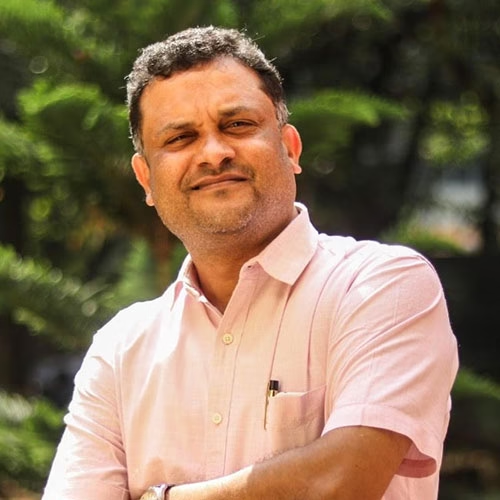
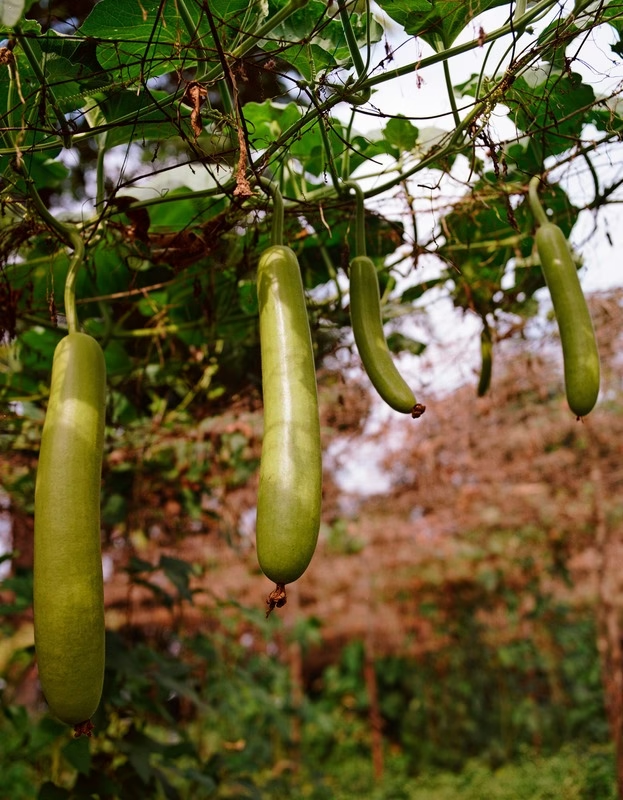
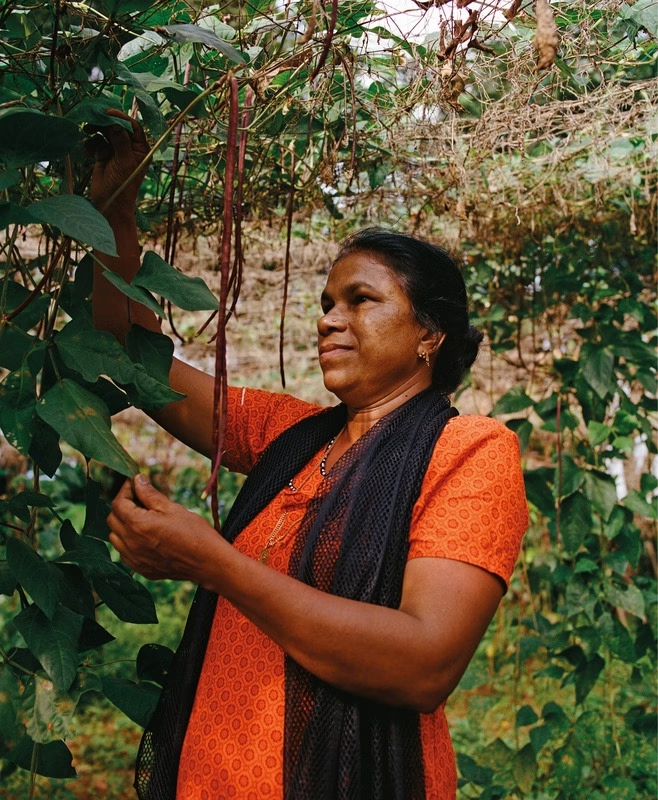
• Mini Santosh carefully winds her way through the thicket of vines that climb up wooden poles. She checks the ripeness of the spiky bitter gourds, the red beans, the green cucumbers. Suddenly the 37-year-old stops, looks around and says with pride in her voice: “This is our farm.”
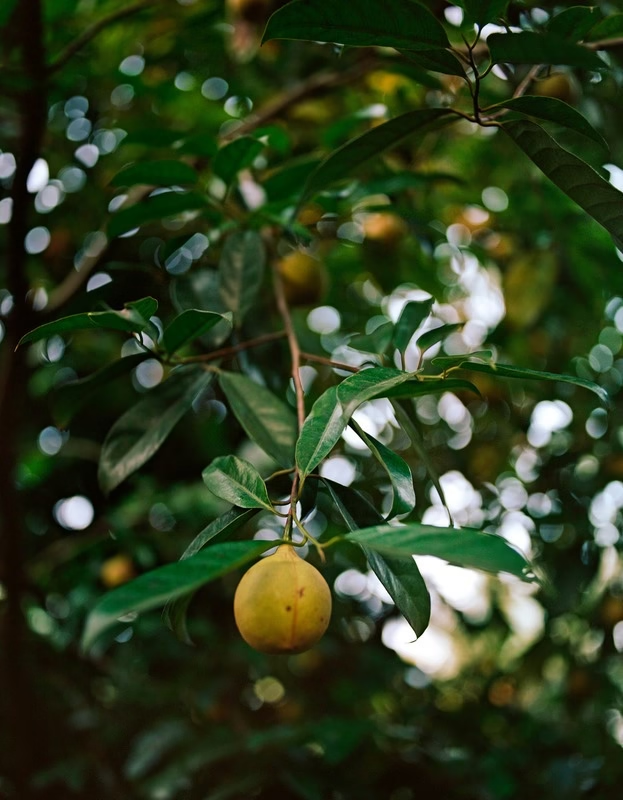
Off the narrow, stony path, surrounded by lush greenery, stands a thatched barn for her two cows. Mini Santosh and her four companions climb this hill several times a day. They pass rubber and moringa trees, coconut palms, nutmeg and betel nut trees and black pepper plants.
Mini Santosh is a farmer, but she owns no land. Her fate seemed sealed: She would spend her life working as a day labourer in other people’s fields, earning so little that she would never be able to rent a field of her own – let alone buy one.
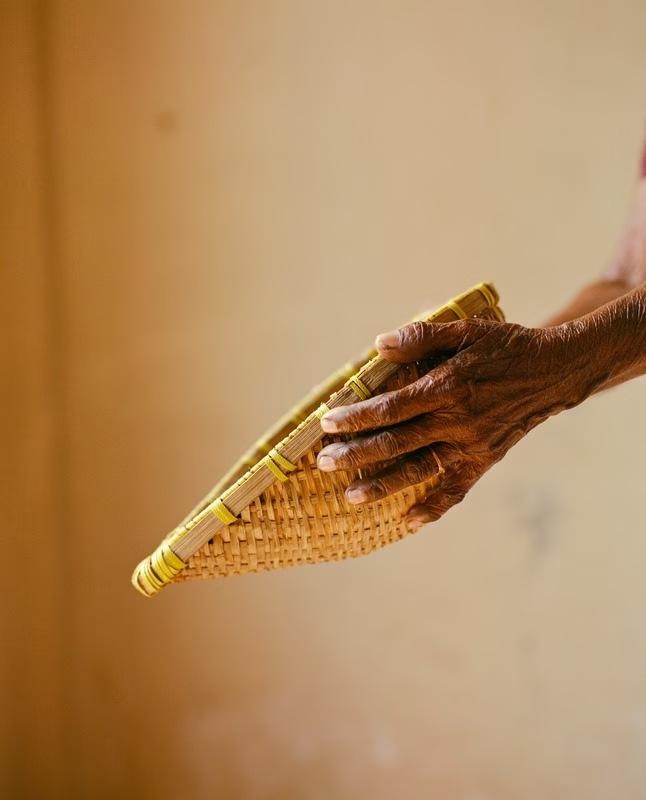
An estimated 144 million people in India share this fate. The fact that the landless Santosh is now running a farm is a miracle, given the perpetual crisis facing India’s farmers (see box). But it is a miracle based not on divine intervention but on smart administrative decisions. And the hard work of five million women.
Today, Mini Santosh heads a group of five women who have leased 12 hectares of farmland in Nadathara, a town of 31,000 people in the Thrissur district in the southern coastal state of Kerala. To add value to their crops, they dry the vegetables they grow, process them into chips and sell them packaged at the market. They also produce coconut oil.
The farmers sell vegetables and spices at local markets for at least eight months of the year. Each of them earns around 168 euros a month – just below the average income of all farmers in the state of Kerala, but well above the national average. “It’s a good income,” says Santosh. Especially for a group of women who have to work hard in the conservative rural society but are not encouraged to become entrepreneurs. Santosh expects her income to continue to rise as she makes production even more efficient.
“I grew up in poverty,” says Mini Santosh. She did not go to secondary school. Her parents were unskilled labourers and she married at the age of 19. From then on, she helped her husband, who worked as a day labourer on a small farm. For three euros a day. For most of the year she had no stable income. Santosh’s four colleagues Sumidha Unnikrishnan, Mini Vinod, Juby Roy and Biji tell similar stories – of rising from abject poverty to a relatively regular and comfortable life.
Eine Frau mittleren Alters steht in üppiger Vegetation und scheint an einer Kletterpflanze zu arbeiten. Sie trägt ein orangefarbenes Kleid mit einem dunklen Schal und blickt nachdenklich in die Ferne. Das Bild vermittelt eine ruhige und konzentrierte Atmosphäre.
From landless woman to entrepreneur: Mini Santosh on her farm
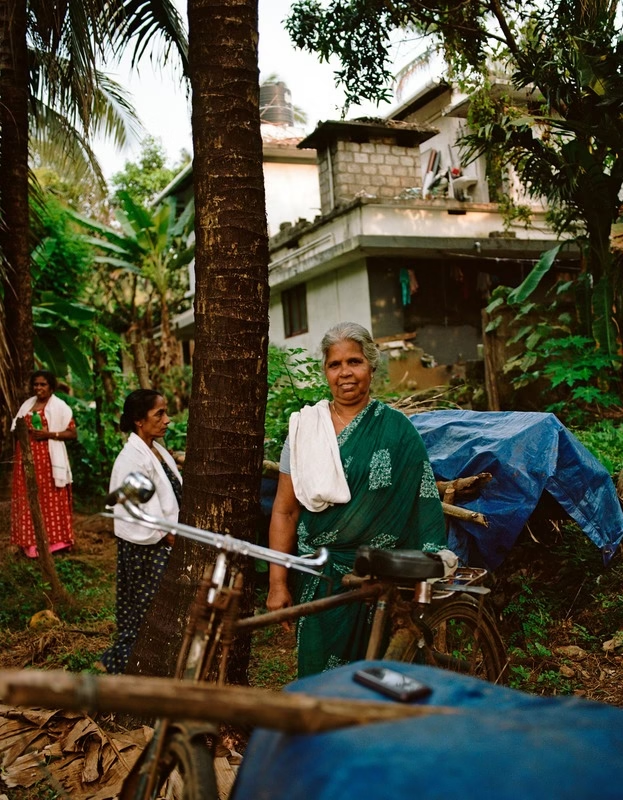
Responding to the agrarian crisis
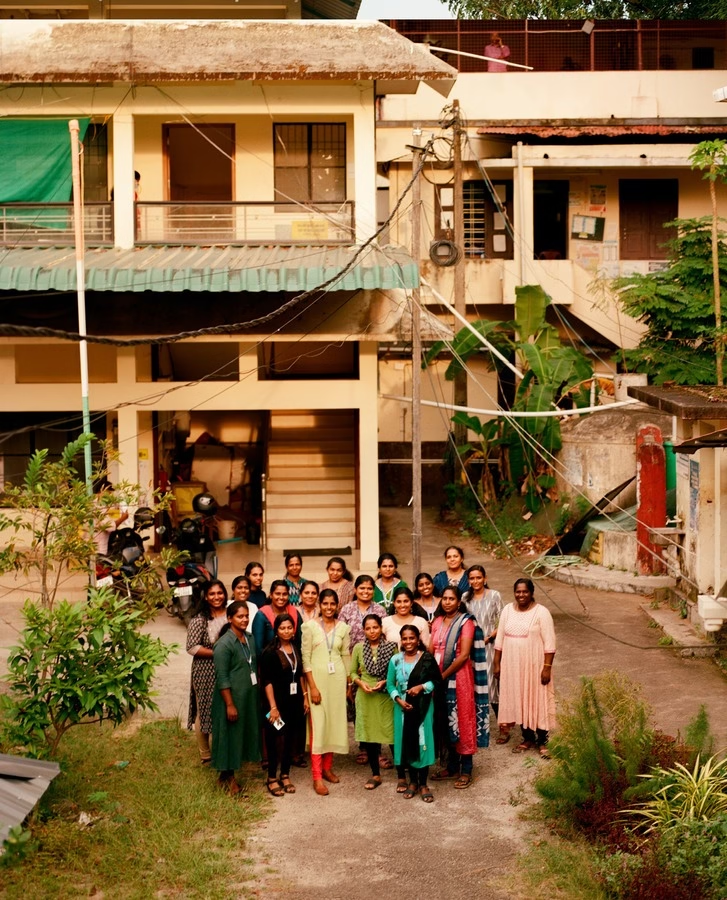
Mini Santosh’s group is supported by an organisation with a, for India, typically complicated name: Mission to Eradicate Poverty in the State of Kerala and Empower Women. It is popularly known as Kudumbashree, which means ‘family prosperity’. Today, the initiative has grown into an enormous network of five million members and countless projects (see box). Kudumbashree is known for the five-member women’s collectives that work together. Like Mini Santosh’s group.
Kudumbashree tackles two of India’s structural problems: the tattering agrarian economy that leads to multidimensional poverty, and the low participation of women in the labour market. Although the latter has increased, it still stands at 37 per cent.
And the agricultural situation has continued to deteriorate. In India, this does not mean that farmers have to fill in too many forms, but that they are so in debt that they are taking their own lives by drinking their own herbicide. And at an alarming rate. According to government figures, around 400,000 farmers commited suicide between 1997 and 2021. That’s an average of 43 deaths a day. And these statistics do not even include farmers’ wives.
Despite economic growth in recent decades, the official unemployment rate is around nine per cent, or nearly 130 million people. In addition to rural and urban unemployment, inequality is also on the rise. It is not surprising, therefore, that farmers’ protests are becoming more frequent and more violent – as in 2020, when farmers blocked roads in the capital, Delhi, for months, attracting global attention.
Kerala, one of India’s most progressive states, is also doing things differently in this area and founded the non-profit organisation Kudumbashree in 1998. The idea: women as problem solvers. Kudumbashree is organised on several levels (see box) and brings together government initiatives to support local livelihoods.
With the help of loans and training from the network, women run small farms, grow food, raise livestock, cook in government schools, run women’s taxis and run small hotels, restaurants and shops. “The question is not what these women can do, but what they can’t do,” says Jafar Malik, head of the network and a senior civil servant in Kerala. So far, there have been no significant loan defaults.
This is not to be taken for granted. Over the past ten years, Indian banks have written off €170 billion in bad loans from large companies – money that could be used to build a good 100,000 kilometres of paved roads in India.
According to an official document from March 2023, the savings of the women in the network amount to €921 million, the loans given internally by Kudumbashree to €2.7 billion and the loans taken from banks to €2.9 billion.
Suddenly independent
Landless Mini Santosh’s rise to entrepreneurship began in 2008 when, on the advice of friends, she went to a Kudumbashree event and joined forces with other women. “We started saving small sums of money,” says Santosh, “it wasn’t such a big deal, but merely coming together for our weekly meetings gave us the confidence that we are not alone in this journey, that we could learn and do new things.”
In 2012, Santosh and her four neighbours formed a formal group of five. They called themselves the Paval Consortium. Paval means bitter gourd in the local Malayalam language. With the help of project staff, the group learned how other Joint Liability Groups (JLGs) worked. And their confidence grew that they too could become entrepreneurs. They started with two hectares of land, which they leased at a reasonable price. They have steadily expanded the area to twelve hectares.
The Paval consortium is one of 7,500 JLGs in Thrissur district, which includes Nadathara. According to the charity, there are more than 200,000 such collectives in Kerala, collectively cultivating more than 60,000 hectares – often on previously fallow land. Local governments promote the leases by making unused government or private land available.
In addition to landlessness, the project addresses another problem: the fragmentation of farms in Kerala. A good two-thirds of the state’s 6.8 million farming households farm less than two hectares, and most farm less than half a hectare. With less than two hectares and the usual farming methods, no significant income is possible. Added to this are extreme weather conditions, such as prolonged droughts and floods, and the volatility of global agricultural markets.
“Farming is a lot of work,” says Mini Santosh, “but no pain, no gain.” It took the group almost a year to put up the wooden stakes for the climbing plants on their small farm in 2021, in the middle of the covid pandemic, she says. Every day they climbed up the hill to collect logs and build the structure, which would now last for five years.
Figuratively speaking, their climb up the hill is also a social one – one that makes them proud and independent. “We climb this hillock several times a day,” says Mini Santosh, “but we never get exhausted.
Her group does almost everything, from working in the fields and operating the processing machines to marketing and accounting. The idea of turning them into chips has proved particularly lucrative. While a kilo of bitter gourd fetches 22 cents, crisps bring in ten times as much.
Financed by the network and with the help of bank loans, this unit will be able to operate sustainably within a year, say Kudumbashree officials, who supervise and train the women.
Mini Santosh’s group says it received a bank loan of 15,000 euros and a start-up grant of 11,000 euros from Kudumbashree. The women added their savings and bought the equipment to process the food. As well as a vegetable dryer, they now have a slicer, a chopper, a blender and a machine to make coconut oil. In a few years, the group hopes to be debt-free thanks to the additional income.
In a spacious hall with high ceilings and large wooden doors, Mini Santosh demonstrates her production facility. She spreads out moringa leaves on a large tray, puts them in the dryer and then sets them aside to cool. The dried leaves are later packaged and sold at the markets. Rich in vitamins and iron, moringa leaves are used in soups and curries.
The vegetables they process here are still home-grown, but as they expand their business, they will also be buying vegetables from other farmers in the village. “We are now both farmers and entrepreneurs,” says Mini Santosh.
Zwei Frauen sitzen nebeneinander auf dem Boden. Beide tragen farbenfrohe, gemusterte Saris in verschiedenen Rosatönen. Ihre Füße sind nackt und berühren eine Unterlage. Eine dritte Hand ist im Bild zu sehen, die Geld zählt. Die Szene wirkt ruhig und konzentriert.
Entrepreneurial knowledge and emotional support – meeting of a neighborhood group
One woman trains another
“One of the strengths of our system is the constant training, learning and capacity building,” says Deepa A, a program officer who accompanies Santosh’s group as a mentor. “Whatever we do, it must be sufficiently insured against risks, and factor in human follies and chances of failures in the initial stage,” she says. The community decides the path and the pace.
Each member must complete two orientation courses as soon as they join the collective. Santosh’s group also receives training from agricultural officials and marketing experts who help with setting up the business and drawing up business plans.
Other women in the network contribute their own experience and help the newcomers. This creates a close-knit community that supports each other – both professionally and emotionally.
The limits of the collective
“The economic benefits have added to the women’s individual as well as collective dignity, as in the case of near universal achievement in access to a private toilet and clean cooking energy”, write economists K. P. Kannan and G. Raveendran in their recent book Poverty, Women and Capability – A Study of Kerala’s Kudumbashree System. But perhaps the most significant impact has been the women’s newfound confidence, knowledge of government programmes and skills in negotiating with public institutions.
The project has been a great success for Kerala, both economically and socially. But it cannot solve all the problems. Kannan and Raveendra write in their study that while increased visibility has led to increased demand for women’s services, this is often not matched by adequate payment. In short, although women now have jobs, they are still being ripped off. Even local authorities sometimes see Kudumbashree women as a source of cheap labour for unpopular jobs such as waste management duty.
Furthermore some men do not like the women’s new confidence. In her study of Kudumbashree published in 2016, J. Devika, one of Kerala’s leading historians from the Centre for Development Studies (CDS), found that the women’s successes made some dignitaries uncomfortable. They were perceived as “too assertive and even arrogant and disobedient” because of their growing influence.
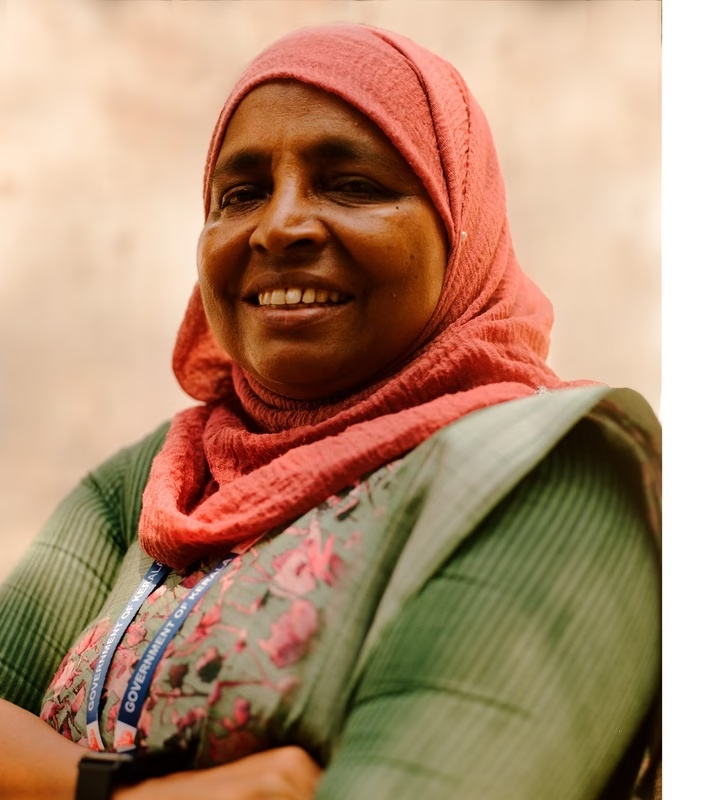
Porträt einer Frau mit dunkler Haut und freundlichem Gesichtsausdruck. Sie trägt ein rosafarbenes Kopftuch und ein gemustertes Oberteil. Sie lächelt warm und wirkt einladend.
Has found a new family in Kudumbashree – mentor Zeenath Hamsa
New neighbourly help
There are millions of stories of progress like Mini Santosh’s in Kudumbashree. Often, the focus is not even on financial advancement, but on social advancement. Such is the case of Zeenath Hamsa, a single Muslim woman in her late 50s in Ernakulam, 100 kilometers from Thrissur. If you’d met her 20 years ago, she would not even dare to lift her face to strangers. Today she runs her own shop and welcomes the reporter as a matter of course. Her husband died in 2004 and her only son in 2008. “I was devastated,” she says with tears in her eyes. “I lost my family, but I found a new one in Kudumbashree.”
After the sudden death of her husband, who ran a small transport company, Hamsa was left without hope or direction. On the advice of a friend from the neighbourhood, she joined Kudumbashree. The mission office gave her a small job, which brought her little income but gave her emotional support.
Two decades later, she is part of the network’s prestigious group of trainers and mentors. Little by little, she learned how to take over the business her husband had inherited. “At Kudumbashree, I got trained in every aspect of business, while I was able to deal with my family problems,” she says, wiping away tears as her colleagues comfort her in their arms. Most of the women in the collective have struggled and suffered in their lives.
Zeenath Hamsa has brought many poor Muslim women to Kudumbashree and has managed to gain the trust of Muslim men in the organisation. According to official statistics from 2022, the employment rate of Muslim women in India is only 15 per cent – far below the already low national average. “It’s not very common for Muslim women to come out and join such groups”, Hamsa says. That, she adds, is partly because of the community’s conservative nature: “Now I want to be a support to them as much as I wanted support for myself. We are all in the same boat – alone, burdened by responsibilities, without any freedom or money!”
Across Kerala, thousands of women like Zeenath Hamsa are the pillars of Kudumbashree. They have mobilised other women from marginalised and minority groups, educated themselves, learnt new skills, started their own businesses and played their part in the success, becoming ambassadors of a new female confidence in rural India.
Or as one of Zeenath Hamsa’s colleagues recently put it: “If you educate a man, you educate only one person – but if you educate a woman, you educate the entire family.” —
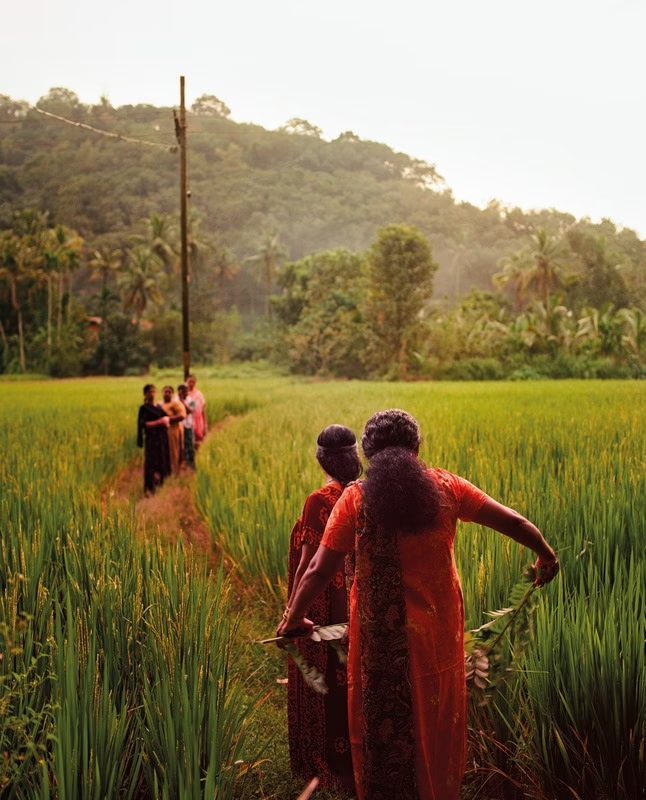
Zwei Frauen in roten Kleidern stehen mit dem Rücken zum Betrachter auf einem Reisfeld. Sie scheinen zu arbeiten. Im Hintergrund sind weitere Personen in einer Gruppe zu sehen, die sich von den beiden Frauen entfernen. Das Feld erstreckt sich vor einer Hügelkulisse mit dichter Vegetation. Das Licht wirkt warm und deutet auf eine ruhige Atmosphäre hin.
Finding their own way – women of the Kudumbashree project in their rice field in the district of Thrissur in southern India
What is Kudumbashree?
Kudumbashree is a network of nearly five million women today. It is based on an initiative launched by the communist ruled state of Kerala in 1997 in response to the agrarian crisis and discrimination against women. Kudumbashree aims to eradicate poverty and increase the role of women in society. To this end, the government supports small groups of entrepreneurial women. The organisation is seen as a model for the whole country. The structure of Kudumbashree reflects the soul of Indian bureaucracy. Put simply, this is how the network is organised: It starts with the formation of a Neighbourhood Group (NG) of ten to twenty women, with each family allowed to send only one woman. The five-member women’s groups (JLG) are then formed at this level. However, several NHGs can join together to form an Area Development Society (ADS), which in turn becomes part of a Community Development Society (CDS). Each of these units works at its own level with local authorities, which are part of the Indian panchayat system – a kind of village council, only more complicated. According to official figures, Kudumbashree is organised in more than 300,000 NHGs, which have come together to form 20,000 ADSs and around 1,100 CDSs in Kerala.
Kudumbashree 2024/25 is funded by the state government of Kerala with nearly 30 million euros. The large scale project also has offshoots, for which millions more are being raised from all sorts of state and other sources. Due to the complex nature of the project, the exact amount of funding is unknown.
According to a 2015 study, the women in the collective generate around €430 million a year. Today it is estimated at around €560 million. In 2015, the average income of a member was around €230. By comparison, the average income of agricultural households across India in 2019 was €110 per month.
One of the most important activities is the development of women’s micro-enterprises, mostly in agriculture – like Mini Santosh’s. Women currently run more than 100,000 businesses, including many small ones, but also larger ones such as Café Kudumbashree with more than 1,000 outlets across Kerala. The proportion of women in Kerala’s working population has risen sharply between 2005 and 2022 – from 38 per cent to 58 per cent.
Agriculture
currently accounts for about 17 per cent of India’s gross domestic product (GDP). The IT industry, for which India is world-renowned, has declined by half in recent years to about 8 per cent of GDP. India is the world’s largest producer of milk, pulses and jute, and the second largest producer of rice, wheat, sugarcane, vegetables, fruit and cotton, vegetables, fruits and cotton. Agriculture and allied sectors are the main source of livelihood in India. 70 per cent of rural households depend mainly on agriculture and animal husbandry, and 82 per cent of farmers are smallholders. Across the country, about 250 million people work directly in agriculture, almost half of the total labour force.
The number of people employed in the sector fell by 67 million between 2004 and 2018, as many moved to better-paying jobs in industry and services. In the following years, however, the number of farmers rose by 60 million, as not enough jobs were created in other sectors.
Protests
Many farmers can barely make a living from their work and are deeply in debt. Some take their own lives in despair: The state of Maharashtra recorded the highest number of farmer suicides in 2023, with 2708. The southern state of Karnataka was second with more than 1,300 deaths by suicide. Debt and bankruptcy are the main reasons.
In 2020/21, farmers in Delhi protested against agrarian reform and market liberalisation. Plans included the abolition of the government guaranteed minimum price for rice and wheat. Protesters often block railway lines and roads. In 2021, there were violent clashes with police in Delhi as farmers demanded a minimum purchase price that was 50 per cent higher than their cost of production. A government-appointed committee of experts had demanded this in 2006. They also demanded debt cancellation, pensions for farmers over 60, a substantial wage increase and a guarantee of employment for 200 days a year. And that India should withdraw from the World Trade Organisation. The majority of the protesting farmers come from wealthy Punjab. This may be due to its geographical proximity to the state capital, Delhi, but also to the fact that better-off farmers there can organise themselves more professionally and get involved politically.
Women
officially make up just under a third of India’s agricultural workforce. But because they often work as unpaid helpers to their husbands, the real figure is likely to be much higher. Estimates put the female participation rate at around two-thirds – far higher than in any other sector. This is partly because more and more men are migrating to the cities to work. Women stay behind and take over agricultural work.